Paris green
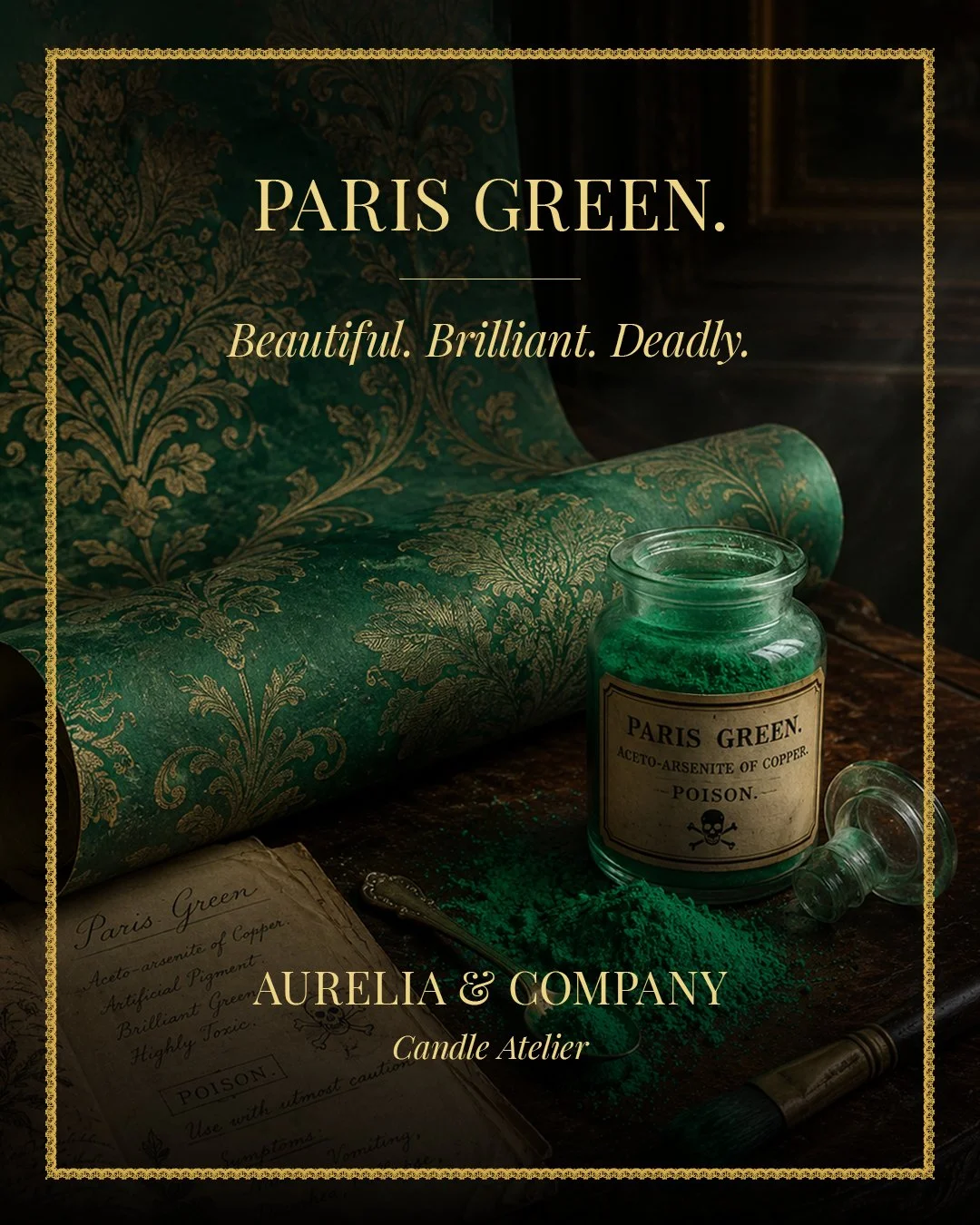
There are colors that decorate history—and then there are colors that leave a body count.
Paris Green did both.
Brilliant, vivid, and almost unnaturally beautiful, Paris Green became one of the most fashionable pigments of the 19th century. Its striking blue-green hue appeared in wallpaper, paintings, printed books, clothing, artificial flowers, and household décor.
There was only one rather unfortunate problem.
Paris Green contained arsenic.
A Color Worth Dying For
Paris Green emerged in the early 19th century as a copper arsenic pigment prized for a color unlike the duller greens that preceded it. Bright and remarkably vibrant, it quickly found its way into fashionable interiors and decorative objects.
And the Victorians loved green.
Elaborately patterned wallpapers transformed rooms into lush botanical spaces. Green pigments appeared on fabrics, paper, toys, decorative objects, and even artificial flowers.
But achieving those spectacular shades could come at a cost.
Paris Green was made using arsenic, a substance whose toxicity was already becoming increasingly understood during the 19th century. Those who manufactured arsenic-containing pigments—or worked extensively with materials colored by them—could face particularly significant exposure.
Imagine spending your working day surrounded by clouds of brilliant green pigment, knowing that the very substance creating such extraordinary beauty was also capable of poisoning you.
It is a contradiction that feels almost impossible to resist:
Something beautiful made from something deadly.
Poison on the Walls
Perhaps nowhere is the story of arsenical green more evocative than in Victorian wallpaper.
Richly patterned walls covered homes with flowers, vines, leaves, and elaborate geometric designs. Green was especially fashionable, and arsenic-based pigments were used in some wallpapers to achieve those coveted shades.
As concerns about arsenic-containing products grew, so did public debate over their safety.
The danger wasn't simply that someone might decide to eat the wallpaper—which, admittedly, would have been ill-advised.
Dust and pigment could be released as materials deteriorated or were handled. Questions also arose about whether damp conditions and microorganisms could contribute to the release of arsenic-containing compounds from wallpaper.
The beautiful green room suddenly didn't seem quite so charming.
The Poisoned Book
The story becomes even more fascinating when Paris Green and related arsenical pigments turn up somewhere unexpected:
books.
Researchers and conservators have identified 19th-century books whose vivid green cloth or paper coverings contain arsenic-based pigments.
These objects are remarkable because they transform what appears to be an ordinary antique book into something requiring decidedly extraordinary handling.
Libraries and museums have had to identify, isolate, and establish safe handling practices for arsenic-containing books in their collections.
A beautiful Victorian volume sitting quietly on a shelf may carry a little more history than anyone bargained for.
At Aurelia, naturally, we find that fascinating.
From Fashionable Pigment to Insecticide
Paris Green's usefulness did not end when people began questioning whether arsenic belonged on their walls.
Its toxicity became an asset.
The pigment was eventually used extensively as an insecticide, including against agricultural pests. The same chemical properties that made Paris Green dangerous to humans made it quite effective at killing insects.
A fashionable pigment had become a poison with a purpose.
And therein lies perhaps the most fascinating part of the Paris Green story: throughout its history, beauty and toxicity were never particularly far apart.
The Inspiration Behind Our Paris Green Candle
That contradiction became the inspiration for Paris Green, part of Aurelia & Company's Particular Poison Collection.
The fragrance combines:
Green Tea • Jasmine • Lemongrass
Green tea provides the fresh, verdant heart of the fragrance. Lemongrass brings brightness and clarity, while jasmine adds an elegant floral note.
The result is crisp, botanical, and sophisticated.
Beautiful on the surface.
With a much darker story underneath.
Fortunately, unlike its namesake, our Paris Green is intended to make your room smell lovely—not poison its occupants.
We consider that an improvement.
Beauty Has Always Had a Dark Side
The history of Paris Green is more than a strange tale about poisonous wallpaper.
It is a reminder that some of the most ordinary objects can contain extraordinary stories.
A book.
A patterned wall.
A fashionable dress.
A particular shade of green.
Look closely enough, and history has a habit of becoming considerably stranger.
And at Aurelia & Company, those are precisely the stories we like best.
Paris Green
Green Tea • Jasmine • Lemongrass
From the Particular Poison Collection by Aurelia & Company.
Beautiful. Brilliant. Deadly.